Introduction
Industrial automation systems demand microcontrollers that deliver exceptional processing power, reliability, and real-time performance in harsh environments. 32-bit MCUs have become the standard, offering superior memory addressing (up to 4GB), faster execution of complex control algorithms, and integrated peripherals that 8-bit and 16-bit alternatives simply cannot match.
These advanced MCUs enable critical automation capabilities including predictive maintenance analytics, Industry 4.0 connectivity, and sophisticated motor control. They operate reliably in temperature extremes from -40°C to +105°C.
The 2023 industrial landscape presents unique challenges. Supply chain constraints persist despite easing semiconductor shortages, with lead times for critical industrial MCUs still extending 28-52 weeks for major suppliers like NXP and STMicroelectronics.
Selecting the right 32-bit microcontroller requires balancing technical performance with practical considerations including long-term availability, ecosystem maturity, and reliable sourcing strategies that ensure component access throughout your product's lifecycle.
TLDR
32-bit MCUs deliver 4-10x faster processing with larger memory and integrated peripherals
Industrial selection requires extended temperature range, real-time performance, and security features
STM32F4, ESP32, PIC32MX, LPC55S, and MSP430FR excel across motor control to wireless sensing
Partner with distributors offering global sourcing, ESD storage, and mil-spec capabilities
Verify manufacturer availability commitments to avoid obsolescence in 5-10 year lifecycles
Overview of 32-Bit Microcontrollers in the Industrial Automation Industry
A 32-bit microcontroller processes data in 32-bit words using 32-bit registers and buses, enabling direct addressing of up to 4GB of memory—a significant capability compared to the 64KB limitations of most 8-bit architectures.
The industrial automation market was valued at $191.28 billion in 2023 and is projected to reach $363.31 billion by 2030. This growth increasingly relies on 32-bit MCUs for applications spanning programmable logic controllers (PLCs), precision motor control, human-machine interfaces (HMI), and Industry 4.0 edge computing.
These MCUs held 56.35% of the global microcontroller market share in 2025, reflecting their dominance in applications requiring advanced control algorithms, floating-point mathematics, and robust connectivity. Component availability remains critical—ongoing supply chain constraints throughout 2023 created 28-52 week lead times for industrial-grade MCUs, making sourcing reliability as important as technical specifications.
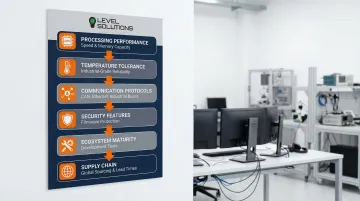
Given these supply challenges, selecting the right MCU requires careful evaluation. The following sections identify the top five 32-bit microcontrollers specifically designed for industrial automation, assessed across:
- Processing performance and memory capacity
- Temperature tolerance and industrial-grade reliability
- Communication protocol support (CAN, Ethernet, industrial buses)
- Security features and firmware protection
- Ecosystem maturity and development tool availability
- Global sourcing availability and lead times
Top 5 Best 32-Bit Microcontrollers for Industrial Automation in 2026
Selection criteria prioritize real-world industrial requirements:
- Processing power for complex control loops
- Extended temperature operation (-40°C to +105°C)
- Deterministic real-time performance
- Industrial communication protocols (CAN, Ethernet, RS-485)
- Hardware security features
- Long-term availability from reliable supply chains
STM32F4 Series (STMicroelectronics)
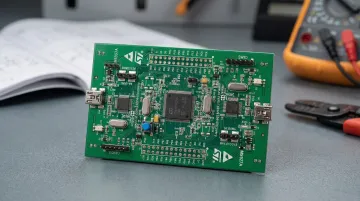
The STM32F4 series from STMicroelectronics, particularly the F407 and F429 variants, has achieved widespread adoption in automation applications due to its exceptional balance of performance, peripheral integration, and ecosystem support.
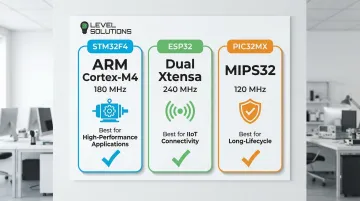
This MCU features an ARM Cortex-M4 core with integrated DSP instructions and floating-point unit (FPU), delivering real-time performance up to 180 MHz with 225 DMIPS throughput. This combination enables sophisticated motor control algorithms, FFT-based vibration analysis, and precision closed-loop control.
The extensive peripheral set includes CAN, USB, Ethernet MAC, and up to 15 communication interfaces. Industrial temperature variants operate reliably from -40°C to +105°C (some to +125°C), while AEC-Q100 qualified options provide automotive-grade reliability for critical applications.
STM32F4 Technical Specifications
| Category | Specifications |
|---|---|
| Processing & Performance | ARM Cortex-M4 core, up to 180 MHz, DSP instructions, floating-point unit, 1.25 DMIPS/MHz, 608 CoreMark score |
| Memory & Connectivity | Up to 2 MB Flash (dual-bank), 384 KB RAM, CAN, I2C, SPI, USART, USB OTG, Ethernet MAC, camera interface |
| Industrial Features | -40°C to +85°C standard (-40°C to +105°C/+125°C variants), AEC-Q100 qualified options, advanced motor control timers, DMA channels |
ESP32 Series (Espressif Systems)
The ESP32 from Espressif Systems provides cost-effective wireless connectivity for Industrial IoT applications. It's the preferred choice for wireless sensors, IIoT gateways, and edge computing nodes where integrated Wi-Fi and Bluetooth eliminate external communication modules.
This dual-core Xtensa LX6 processor runs up to 240 MHz, delivering 1079 CoreMark in dual-core mode. It features integrated 802.11 b/g/n Wi-Fi and Bluetooth 4.2/BLE, with ultra-low power consumption modes reaching just 5 µA in deep sleep. Hardware cryptographic acceleration ensures secure data transmission.
The peripheral set includes CAN, SPI, I2C, and UART for industrial protocol support. Strong community support and mature development frameworks enable rapid prototyping and deployment.
ESP32 Technical Specifications
| Category | Specifications |
|---|---|
| Processing & Performance | Dual-core Xtensa LX6, up to 240 MHz, 600 DMIPS combined, 1079 CoreMark (dual-core), hardware crypto acceleration |
| Memory & Connectivity | Up to 16 MB external Flash, 520 KB SRAM, Wi-Fi 802.11 b/g/n, Bluetooth 4.2/BLE, CAN, SPI, I2C, UART |
| Industrial Features | -40°C to +85°C operation (-40°C to +105°C variants), ultra-low power (5 µA deep sleep), secure boot, flash encryption, battery-friendly |
PIC32MX Series (Microchip Technology)
The PIC32MX series from Microchip Technology is a proven industrial workhorse built on the MIPS32 architecture. It excels in motor control, instrumentation, and real-time control applications where predictable interrupt response is non-negotiable.
This MCU features a MIPS M4K core with 5-stage pipeline architecture delivering up to 120 MHz performance at 1.56 DMIPS/MHz. The architecture provides deterministic interrupt latency critical for safety-critical control loops. Comprehensive peripheral integration includes high-speed PWM modules optimized for motor control, CAN 2.0B, USB 2.0, and parallel master port for graphics interfaces.
The mature MPLAB X development environment and Microchip's "Client-Driven Obsolescence" policy ensure long-term product availability. The company pledges not to discontinue products with active demand, achieving negligible EOL rates (~0.2%) in 2022-2023.
PIC32MX Technical Specifications
| Category | Specifications |
|---|---|
| Processing & Performance | MIPS32 M4K core, up to 120 MHz, 1.56 DMIPS/MHz, 5-stage pipeline, deterministic interrupt response |
| Memory & Connectivity | Up to 512 KB Flash, 128 KB RAM, CAN 2.0B, USB 2.0 Host/Device/OTG, I2C, SPI, UART, parallel master port |
| Industrial Features | -40°C to +85°C operation (-40°C to +105°C variants), advanced PWM for motor control, DMA channels, fail-safe clock monitor, extended lifecycle support |
LPC55S Series (NXP Semiconductors)
NXP Semiconductors' LPC55S series features ARM TrustZone-M technology for security-first design. This makes it optimal for secure industrial gateways, access control systems, and IIoT applications requiring hardware-enforced security isolation.
The ARM Cortex-M33 core incorporates TrustZone-M security extensions, running at up to 150 MHz with 213 CoreMark performance (4.02 CoreMark/MHz—an 18% efficiency gain over Cortex-M4). Hardware security features include PRINCE real-time flash encryption, AES-256/SHA-2 cryptographic accelerators, SRAM PUF (Physically Unclonable Function) for unique key generation, and secure boot with firmware update capabilities.
FlexComm interfaces provide flexible configuration as I2C, SPI, UART, or I2S, while CAN FD support enables high-speed industrial networking.
LPC55S Technical Specifications
| Category | Specifications |
|---|---|
| Processing & Performance | ARM Cortex-M33 with TrustZone-M, up to 150 MHz, DSP extension, FPU, 213 CoreMark, 4.02 CoreMark/MHz efficiency |
| Memory & Connectivity | Up to 640 KB Flash, 320 KB SRAM, FlexComm (I2C/SPI/UART/I2S configurable), CAN FD, USB, Ethernet MAC |
| Industrial Features | -40°C to +105°C operation, hardware security (AES, SHA, PRINCE encryption), secure boot, tamper detection, power management |
MSP430FR Series (Texas Instruments)
Texas Instruments' MSP430FR series offers ultra-low-power operation through innovative FRAM technology. This makes it ideal for battery-powered industrial sensors, energy harvesting applications, and remote monitoring systems where power efficiency is paramount.
FRAM (Ferroelectric RAM) non-volatile memory provides unlimited write endurance (10^15 cycles) and 100-year data retention without the wear limitations of Flash memory. This technology solves durability challenges in high-frequency data logging applications.
The 16-bit RISC architecture with 32-bit hardware multiplier extensions operates at up to 24 MHz while consuming just 40 µA/MHz in active mode and 100 nA in standby mode. Integrated 12-bit ADC enables precision analog measurements, while support for energy harvesting power sources makes it perfect for wireless sensor networks where battery replacement is impractical.
MSP430FR Technical Specifications
| Category | Specifications |
|---|---|
| Processing & Performance | 16-bit RISC CPU with 32-bit extensions, up to 24 MHz, 40 µA/MHz active power, FRAM memory technology with 10^15 write cycles |
| Memory & Connectivity | Up to 256 KB FRAM, up to 8 KB RAM, I2C, SPI, UART, USB, integrated 12-bit ADC |
| Industrial Features | -40°C to +85°C (-40°C to +105°C variants), ultra-low power (100 nA standby), unlimited FRAM write cycles, energy harvesting support, wireless sensor networks |
How We Chose the Best 32-Bit Microcontrollers
Engineers frequently make critical selection mistakes when choosing industrial MCUs. Common pitfalls include overlooking extended temperature ratings that cause field failures, underestimating long-term availability concerns that force costly redesigns, and focusing solely on unit price while neglecting total ecosystem costs.
To avoid these mistakes, our evaluation focused on factors tied to business outcomes and real-world deployment success:
- Industrial certifications: AEC-Q100 automotive-grade reliability and IEC 61508 functional safety documentation for safety-critical systems
- Deterministic interrupt latency measured by EEMBC CoreMark benchmarks, not just clock speed
- Supply chain stability: Multi-source availability, manufacturer longevity commitments, and lead time history during 2023 shortages
- Development tool quality, technical documentation depth, community support, and middleware availability
- Security features: Hardware cryptographic acceleration, secure boot, and TrustZone isolation for IIoT connectivity
- Total cost of ownership including development time, debugging tools, technical support access, and long-term maintenance costs beyond chip price
Supply chain considerations extend beyond the MCU itself. Reliable component availability requires sourcing partners with comprehensive manufacturer coverage and global inventory access. Distributors offering both commercial and mil-spec capabilities—with ESD-compliant warehouses like LEVEL SOLUTIONS—help ensure project continuity throughout product lifecycles, especially during industry shortages.
Conclusion
Selecting the right 32-bit microcontroller for industrial automation demands balancing technical specifications with practical considerations that extend far beyond datasheet performance numbers. Processing power, reliable real-time performance, and peripheral integration matter, but so do long-term availability commitments, ecosystem maturity, and supply chain resilience—especially given the persistent lead time challenges throughout 2023.
Start by assessing your automation requirements systematically:
- Processing needs for control algorithms and sensor integration
- Communication protocols (CAN, Ethernet, RS-485) your system requires
- Environmental conditions (-40°C to +105°C operation for industrial settings)
- Security requirements for IIoT connectivity and remote access
- Power constraints for remote installations or battery-powered nodes
Match these requirements to MCU strengths—STM32F4 for high-performance motor control, ESP32 for wireless IIoT nodes, PIC32MX for long-lifecycle reliability, LPC55S for security-critical applications, or MSP430FR for ultra-low-power sensing.
Secure your supply chain by working with component suppliers who offer immediate inventory availability, global sourcing networks for allocation components, and comprehensive manufacturer coverage across commercial and mil-spec grades. This approach reduces procurement lead times, minimizes project risks from supply disruptions, and ensures component access throughout your product's 5-10 year industrial lifecycle.
Frequently Asked Questions
Which microcontroller is best for industrial applications?
ARM Cortex-M based 32-bit MCUs like the STM32F4 and NXP LPC55S are widely preferred for industrial automation. They offer optimal processing performance, reliability under harsh conditions, extensive peripheral integration, and mature ecosystem support with long-term availability.
What is better, 8-bit or 32-bit?
32-bit MCUs deliver 4-10x faster processing, larger memory addressing (up to 4GB versus 64KB), hardware floating-point math for precision control, and richer peripheral sets with integrated communication interfaces. These advantages make them essential for complex control algorithms and Industry 4.0 connectivity demands.
What is an example of a 32-bit microcontroller?
Popular examples include the STM32F407 (ARM Cortex-M4 at 180 MHz), ESP32 (dual-core Xtensa at 240 MHz), PIC32MX795F512L (MIPS32 at 120 MHz), and NXP LPC55S69 (ARM Cortex-M33 at 150 MHz). These are widely deployed in industrial applications from motor control to secure IIoT gateways.
What are the key features to look for in industrial automation microcontrollers?
Essential features include extended temperature range (-40°C to +85°C minimum), industrial communication protocols (CAN, Ethernet, RS-485), real-time performance with deterministic interrupt handling, sufficient memory (512 KB+ Flash), hardware security features, and long-term availability commitments from manufacturers.
How do 32-bit microcontrollers improve industrial automation performance?
32-bit MCUs enable faster execution of complex control algorithms like FFT-based predictive maintenance, support hardware floating-point math for precision control, provide larger memory for sophisticated applications and OTA updates, and offer better connectivity with integrated Ethernet and CAN controllers for Industry 4.0 implementations.
Where can I source reliable 32-bit microcontrollers for industrial projects?
Source from authorized distributors offering verified industrial-grade components with proper certifications and ESD-compliant storage. Level Solutions provides immediate availability from local warehouses plus global sourcing capabilities for hard-to-find components, supporting both commercial and military-spec requirements.