
Introduction
Engineers designing data acquisition systems face a critical challenge: extracting accurate analog signals from sensors while managing power budgets, noise, and real-time processing constraints. The challenge isn't just capturing analog signals—it's doing so with the resolution, speed, and reliability that applications demand.
Modern analog sensing systems must balance:
- High-resolution measurements (16-bit to 24-bit ADC precision)
- Fast sampling rates (kSPS to MSPS ranges)
- Low noise floors (<1 LSB INL/DNL)
- Efficient power consumption for battery-operated devices
Microcontrollers with advanced analog capabilities have become the foundation of accurate data acquisition systems. The right MCU eliminates the need for external ADCs, signal conditioning circuits, and discrete amplifiers, reducing both BOM cost and PCB footprint.
Choosing the right microcontroller means understanding more than just ADC resolution. Sampling rates, noise characteristics, peripheral integration, and DMA capabilities all play essential roles in system performance.
TL;DR
- Best MCUs offer 12-16 bit resolution, 1-5 MSPS sampling, low noise, and integrated analog peripherals
- Top choices include STM32H7, ADuCM4050, MSP432E4, LPC546xx, and RA6M4 for diverse applications
- Match ADC specs, channel count, and DMA capabilities to your accuracy and throughput requirements
- Medical devices need precision and low noise; industrial systems need speed and ruggedness; IoT devices need power efficiency
- Right MCU choice reduces development time by months and ensures long-term measurement accuracy
Overview of Microcontrollers in Analog Sensing and Data Acquisition
Choosing the right microcontroller for analog sensing can make or break your data acquisition system. The best MCUs combine high-resolution ADCs with precision voltage references, low-noise power distribution, and programmable gain amplifiers.
These integrated features eliminate external components, reduce noise coupling, and improve system reliability.
The demand for sophisticated analog capabilities is growing fast. The global microcontroller market reached $40.23 billion, with 32-bit MCUs commanding 51.4% revenue share—driven by complex analog processing needs in industrial and consumer electronics.
Industrial IoT deployments demand real-time multi-channel data acquisition with precise timing, while medical wearables require high-precision measurements at ultra-low power. Edge computing architectures increasingly rely on MCUs that handle intelligent analog preprocessing before data reaches the cloud.
This guide examines the top microcontrollers specifically optimized for analog sensing and data acquisition. We selected each based on ADC performance, peripheral integration, and proven success in demanding real-world applications.
Top 5 Best Microcontrollers for Analog Sensing and Data Acquisition in 2026
Selecting the right microcontroller for analog sensing directly impacts measurement accuracy, system power consumption, and development time. We evaluated leading MCUs based on ADC resolution and speed, analog peripheral integration, noise performance, multi-channel capabilities, and proven track record in industrial sensing applications.
STMicroelectronics STM32H7 Series
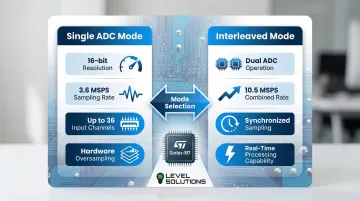
STMicroelectronics leads the ARM Cortex-M7 MCU market, and the STM32H7 series delivers high-performance solutions for multi-channel data acquisition challenges. With dual ADCs capable of 3.6 MSPS and the ability to achieve up to 10.5 MSPS in interleaved mode, these MCUs handle demanding industrial monitoring and medical diagnostic applications with ease.
The STM32H7 combines raw speed with precision enhancement features. The 16-bit ADCs include hardware oversampling adjustable from 2x to 1024x, allowing engineers to trade speed for resolution dynamically.
Advanced DMA capabilities enable continuous background acquisition with circular buffering, while integrated op-amps and comparators reduce external component count. The Cortex-M7 core's DSP instructions deliver real-time signal processing performance that rivals dedicated DSP chips.
| Feature | Specification |
|---|---|
| ADC Specifications | Dual 16-bit ADCs, up to 3.6 MSPS per ADC, hardware oversampling to 20-bit effective resolution, up to 36 analog input channels |
| Key Analog Features | 2 integrated op-amps, 2 ultra-fast comparators, 2 DACs, low-noise voltage reference, programmable gain amplifier options |
| Best Use Cases | High-speed multi-channel data acquisition, industrial process monitoring, motor control with current sensing, medical diagnostic equipment requiring simultaneous multi-parameter sensing |
Analog Devices ADuCM4050
For battery-powered applications, Analog Devices designed the ADuCM4050 specifically for ultra-low-power precision sensing. The 16-bit SAR ADC delivers industry-leading linearity at ±1 LSB INL, while the integrated analog front-end eliminates the need for external signal conditioning in most applications.
Power efficiency sets the ADuCM4050 apart. Hibernate mode consumes just 0.65 µA while maintaining RTC functionality—enabling years of battery life in remote sensing nodes.
Dual 16-bit DACs, four programmable comparators, and integrated voltage regulators create a complete analog subsystem on a single chip. Hardware-based secure key storage makes this MCU particularly attractive for medical devices and industrial sensors requiring data integrity and authentication.
| Feature | Specification |
|---|---|
| ADC Specifications | 16-bit SAR ADC, up to 800 kSPS, ±1 LSB INL, up to 16 single-ended or 8 differential channels, on-chip voltage reference with 6 ppm/°C drift |
| Key Analog Features | Dual 12-bit DACs, 4 programmable comparators, integrated LDO and DC-to-DC converter for analog supply conditioning, low-noise design optimized for precision measurements |
| Best Use Cases | Battery-powered precision sensors, portable medical devices, environmental monitoring stations, industrial sensors requiring long-term accuracy and calibration stability |
Texas Instruments MSP432E4 Series
When connectivity matters as much as analog performance, the MSP432E4 series excels. Dual 12-bit ADCs deliver 2 MSPS combined throughput across 24 analog input channels, while integrated Ethernet MAC and USB interfaces enable seamless data streaming to industrial networks.
The integrated Ethernet PHY eliminates external networking components. Extensive timer resources provide synchronized sampling capabilities essential for multi-sensor systems. TI's mature ecosystem includes comprehensive software libraries, proven industrial communication stacks, and extensive application notes—reducing development time significantly for industrial automation projects.
| Feature | Specification |
|---|---|
| ADC Specifications | Dual 12-bit ADCs, up to 2 MSPS combined, 24 analog input channels, flexible trigger sources including timers and GPIO, hardware averaging for noise reduction |
| Key Analog Features | 12 analog comparators with programmable voltage reference, integrated temperature sensor, flexible sample sequencer with 8-entry FIFO per ADC, DMA support for autonomous operation |
| Best Use Cases | Industrial automation with networked sensors, building management systems requiring distributed data acquisition, test and measurement equipment, automotive sensor hubs |
NXP LPC546xx Series
Speed-critical applications benefit from NXP's LPC546xx series, which features 5 MSPS sampling capability at 12-bit resolution—one of the fastest integrated ADCs available. The unique architecture allows flexible channel configuration and advanced triggering for complex sensing scenarios where timing relationships between multiple signals are critical.
The advanced trigger system supports cross-triggering between timers and ADC modules, enabling precise synchronization with PWM signals or external events. Hardware-based threshold comparison with automatic interrupt generation allows the MCU to react to analog events with minimal latency. Dual result registers enable ping-pong buffering, maximizing throughput in continuous acquisition scenarios.
| Feature | Specification |
|---|---|
| ADC Specifications | 12-bit SAR ADC, up to 5 MSPS, 12 external channels, synchronous and asynchronous modes, hardware-based threshold comparison with interrupt generation |
| Key Analog Features | Flexible input multiplexing, programmable conversion sequences, dual result registers for ping-pong buffering, integrated temperature sensor, low-power modes with ADC retention |
| Best Use Cases | Real-time control systems with sensor feedback, power monitoring and management, audio signal acquisition and processing, multi-sensor fusion applications requiring synchronized sampling |
Renesas RA6M4
Industrial applications requiring autonomous sensor-to-actuator operation should consider the Renesas RA6M4. Up to 37 analog input channels provide exceptional flexibility for multi-sensor systems.
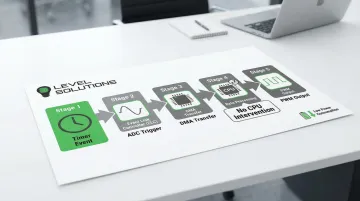
The Event Link Controller (ELC) enables autonomous sensor-to-actuator operation chains without CPU intervention. The ELC can trigger ADC conversions based on timer events, automatically transfer results via DMA, and even trigger PWM updates—all while the CPU remains in sleep mode. This architecture delivers exceptional power efficiency in industrial control applications where continuous monitoring is required but processing overhead must be minimized.
| Feature | Specification |
|---|---|
| ADC Specifications | 16-bit SAR ADC, up to 1 MSPS, 37 analog input channels, ±2 LSB INL typical, group scan and continuous scan modes, internal voltage reference with low temperature drift |
| Key Analog Features | 12-bit DAC with 1 MSPS output, 6 analog comparators, integrated operational amplifiers, temperature sensor, event link controller for hardware-triggered ADC-to-DMA-to-PWM chains |
| Best Use Cases | Industrial sensor nodes requiring long-term stability, motor control with precision current/voltage sensing, HVAC systems with multiple temperature/pressure sensors, renewable energy systems with monitoring and control |
Key Features to Consider When Choosing a Microcontroller for Analog Sensing
Selecting the right MCU for analog sensing requires evaluating multiple technical parameters that directly impact measurement accuracy, system performance, and application suitability.
ADC Resolution and Sampling Rate
ADC resolution determines the smallest voltage change your system can detect. An 8-bit ADC divides the reference voltage into 256 steps, while 12-bit provides 4,096 steps, and 16-bit delivers 65,536 discrete levels.
This translates directly to measurement precision: with a 3.3V reference, 12-bit resolution provides 0.8 mV per step, while 16-bit achieves 0.05 mV per step.
Higher resolution ADCs typically sample more slowly and consume more power. For general industrial sensing—temperature, pressure, flow—12-bit resolution at 100-500 kSPS works well.
Precision medical and scientific applications demand 16-bit resolution, even if sampling rates drop to 100 kSPS or lower. Simple threshold detection or applications where sensor accuracy is the limiting factor may work with 8-bit converters.
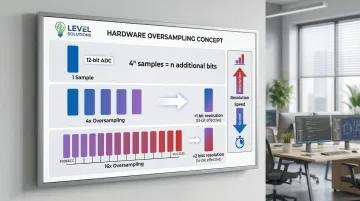
Hardware oversampling bridges this gap. MCUs like the STM32H7 can average multiple samples automatically, trading speed for effective resolution. Oversampling by 4x improves resolution by 1 bit; 16x oversampling gains 2 bits. This technique allows a 12-bit ADC to achieve 14-bit or even 16-bit effective resolution when measuring slowly-changing signals.
Number and Type of Analog Input Channels
Channel architecture impacts both noise immunity and system flexibility. Single-ended inputs measure voltage relative to ground using one pin per channel—simple and pin-efficient.
Differential inputs measure voltage difference between two pins, providing superior noise rejection by canceling common-mode interference. Differential signaling can achieve 80dB CMRR, critical for industrial environments with electrical noise.
Calculate needed channels by:
- Counting sensors
- Adding calibration/reference inputs
- Including power monitoring channels
- Adding 20-30% margin for future expansion
Don't forget internal channels—most MCUs provide temperature sensors and voltage reference monitoring that consume input channel slots.
Most MCUs use multiplexed ADCs—one converter core switching between channels sequentially. This is cost-effective but introduces timing skew between channels. Simultaneous sampling ADCs capture multiple channels at the exact same instant, critical for:
- Motor control (3-phase current sensing where phase relationships matter)
- Power quality monitoring (calculating instantaneous power requires simultaneous voltage and current)
- Audio applications (stereo or multi-channel recording)
- Any scenario where phase relationships between signals are critical
Signal Processing and DMA Capabilities
DMA (Direct Memory Access) is necessary for continuous data acquisition without CPU intervention. The ADC fills memory buffers automatically while the processor handles other tasks or sleeps to save power. Circular DMA mode continuously fills a ring buffer, with the CPU processing data in chunks—ideal for continuous waveform capture or streaming to external interfaces.
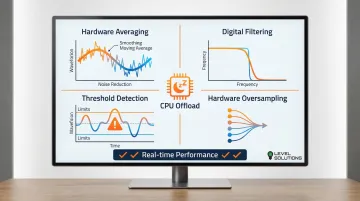
Hardware-based signal processing offloads the CPU further. Features include:
- Hardware averaging — Reduces noise through configurable N-sample moving averages
- Digital filtering — Configurable low-pass filters without CPU cycles
- Threshold detection — Programmable analog watchdogs trigger interrupts on limit violations
- Hardware oversampling — Boost effective resolution by 1-2 bits through automatic decimation
ARM Cortex-M4F and M7 cores with DSP extensions and floating-point units excel at real-time signal processing. The Cortex-M7 delivers 1.7x to 2.1x faster FFT performance than the M4, vital for frequency-domain analysis or sensor fusion algorithms. Single-cycle MAC (Multiply-Accumulate) instructions and SIMD operations make FIR/IIR filtering efficient enough for real-time implementation.
Noise Performance and Reference Voltage Quality
ADC accuracy depends not just on resolution but on noise performance. Effective Number of Bits (ENOB) is often 1-2 bits lower than nominal resolution due to noise.
A 12-bit ADC might deliver only 10-11 bits of usable precision in real-world conditions.
Internal voltage references vary in quality. Temperature coefficient (measured in ppm/°C), long-term stability, and initial accuracy all affect measurement precision over time and temperature. For applications requiring better than 0.1% accuracy or operation over extended temperature ranges, external precision references are required. High-grade references achieve 0.8 ppm/°C drift and 0.02% initial accuracy—far superior to typical internal bandgap references.
Design considerations for minimizing noise:
- Proper PCB layout with separate analog and digital ground planes or star grounding
- Low-ESR capacitors on analog supply rails
- Shielding of sensitive analog traces
- Matching source impedance to ADC input requirements (typically <1 kΩ for high-speed sampling)
- Using differential inputs in electrically noisy environments
Power Consumption and Operating Modes
Battery-operated sensors face strict power budgets. Active ADC operation typically consumes hundreds of microamps to several milliamps, while sleep modes can achieve sub-microamp current draw.
For instance, the ADuCM4050's 0.65 µA hibernate mode enables years of battery life in remote sensing nodes.
Power-saving features specific to analog sensing include:
- ADC operation in low-power modes — Conversions continue while CPU sleeps
- DMA-based acquisition during sleep — Autonomous capture with CPU wake only on buffer-full events
- Wake-on-threshold — Continuous analog monitoring with conditional wake on limit violations
- Event-driven sensing — External triggers initiate conversions, eliminating polling overhead
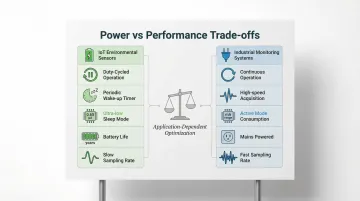
The trade-off between power and performance is significant. Lower power modes typically limit ADC sampling rates, reduce CPU clock speeds, or restrict peripheral availability. IoT environmental sensors might prioritize ultra-low-power sleep modes with periodic wake-up (duty-cycled operation), while industrial monitoring systems prioritize continuous high-speed acquisition with less concern for power consumption.
How We Chose the Best Microcontrollers for Analog Sensing
Our evaluation methodology prioritized ADC specifications (resolution, speed, linearity), analog peripheral integration, noise performance and reference quality, real-world deployment in sensing applications, development ecosystem maturity, and long-term component availability. We examined datasheets, application notes, and real-world deployments to identify MCUs that excel in precision data acquisition.
Understanding these criteria helps avoid common pitfalls in MCU selection:
- Resolution without noise consideration: Choosing devices based solely on ADC bit count results in unusable LSBs
- Insufficient channel count: Underestimating I/O needs leads to costly PCB redesigns
- Missing DMA capabilities: Overlooking direct memory access creates CPU bottlenecks during continuous sampling
- Inadequate analog peripherals: Selecting MCUs without integrated comparators or DACs requires expensive external components
Matching MCU capabilities to your application requirements prevents both over-engineering and underperformance. Over-specifying adds unnecessary cost and complexity, while under-specifying causes performance limitations or product failures.
Prototype early with evaluation boards to validate analog performance under real-world conditions. Noise characteristics, thermal behavior, and interference susceptibility often differ significantly from datasheet specifications.
Conclusion
Selecting the right microcontroller for analog sensing and data acquisition requires balancing ADC performance, peripheral integration, power efficiency, and development ecosystem support.
The optimal choice depends on specific application requirements rather than simply choosing the highest specifications—a 16-bit ADC running at 3.6 MSPS may be overkill for a temperature monitoring system, while a 12-bit converter at 5 MSPS could bottleneck a multi-channel power analyzer.
When finalizing your selection, consider these critical factors:
- Prototype with evaluation boards to validate analog performance in your actual operating environment
- Assess long-term component availability and supply chain reliability—MCU obsolescence mid-product lifecycle creates costly redesign work
- Evaluate total system cost including external analog components that better MCU integration might eliminate
Component availability directly impacts development timelines in 2025's supply chain environment. Partnering with experienced distributors like Level Solutions—with immediate availability of millions of components and global sourcing capabilities—helps keep your development schedule on track.
Frequently Asked Questions
How to choose the correct microcontroller?
Define your requirements: ADC resolution and speed, analog channel count, signal processing needs, power budget, and connectivity. Match these against MCU specifications while considering development tools and long-term availability.
What is the most widely used microcontroller?
The STM32 family (particularly STM32F4 and STM32H7 series) and Texas Instruments MSP432 series dominate analog sensing applications in 2025, thanks to strong analog capabilities and extensive development ecosystems.
What ADC resolution do I need for my sensing application?
12-bit resolution (0.024% of full scale) works for most industrial sensing. 16-bit resolution (0.0015%) is needed for precision measurement and medical devices. 8-bit suffices for simple threshold detection.
What's the difference between SAR and Delta-Sigma ADCs in microcontrollers?
SAR (Successive Approximation Register) ADCs are faster and more common, handling multi-channel applications from kSPS to MSPS. Delta-Sigma ADCs offer higher resolution and better noise rejection at lower speeds for precision measurement applications.
How many analog input channels do I need in a microcontroller?
Count all sensors, calibration inputs, and power monitoring channels, then add 20-30% margin for expansion. Consider whether simultaneous sampling is needed or if time-multiplexed sequential sampling meets your timing requirements.
Can microcontrollers handle high-speed data acquisition?
ARM Cortex-M4/M7 MCUs handle continuous acquisition up to several MSPS using DMA transfers. Sustained high-speed streaming requires careful system design considering memory bandwidth and interface speeds to prevent buffer overruns.