Introduction
The global industrial automation market is projected to reach USD 226.76 billion in 2025, expanding to USD 504.38 billion by 2033 as manufacturers accelerate digital transformation efforts.
Every automated assembly line, robotic cell, and smart factory depends on a complex network of electronic components—sensors, PLCs, motion controllers, and IIoT modules—sourced from specialized distributors who understand industrial application demands.
Choosing the right electronic component supplier directly impacts project timelines, system reliability, and your ability to adopt emerging technologies like AI-enabled automation and edge computing.
The best suppliers don't just stock parts. They deliver:
- Technical expertise for complex component selection
- Supply chain resilience during shortages
- Early access to next-generation automation technologies
TL;DR
- Millions of automation components available from 1,000+ manufacturers with real-time inventory tracking
- Same-day shipping and engineering support accelerate Industry 4.0 implementations
- Evaluate suppliers on automation portfolio depth, ISO 9001/AS9120 certifications, and supply chain stability
- Specialized industrial portfolios and manufacturer partnerships enable emerging automation technologies
Overview of Electronic Components in the Automation Industry
Electronic components form the foundation of modern automation systems. These include sensors that detect position and presence, PLCs that execute control logic, HMIs that provide operator interfaces, motor drives that control motion, power supplies that ensure stable operation, communication modules that enable data exchange, and IIoT devices that connect equipment to enterprise systems.
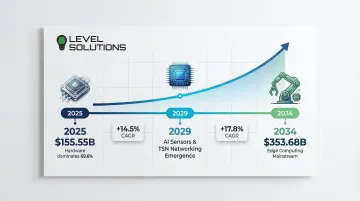
This expanding ecosystem drives significant market growth. The automation components market is valued at $155.55 billion in 2025, projected to reach $353.68 billion by 2034.
Industry 4.0 adoption fuels this expansion as manufacturers integrate AI-enabled sensors, time-sensitive networking (TSN) for deterministic communication, and collaborative robotics components that work safely alongside human operators.
Several key dynamics shape component demand across the industry:
- Hardware components account for 69.6% of industrial automation spending, significantly outpacing software investments
- Manufacturers are deploying edge computing modules, AI inference processors, and advanced sensor fusion solutions
- The automotive sector holds 33% market share for automation components, driven by robotic assembly applications
- Motors alone represent 23% of automation component revenue due to their fundamental role in mechanical actuation
Component suppliers enable this innovation by providing early access to emerging technologies like AI-capable vision sensors and TSN-compatible Ethernet switches. They also maintain inventory depth for legacy systems that require long-term support.
Top Electronic Component Suppliers Driving Automation Innovation in 2026
When sourcing electronic components for automation projects, engineers need suppliers with deep technical expertise and reliable inventory. These five distributors lead the industry in 2025 through extensive automation portfolios, strong manufacturer partnerships, and specialized support for industrial applications.
Digi-Key Electronics
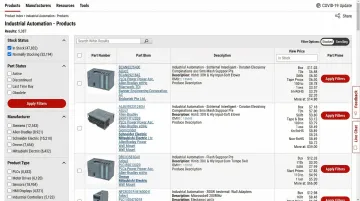
Founded in 1972 and headquartered in Thief River Falls, Minnesota, Digi-Key has grown into one of the world's largest electronic component distributors. The company stocks over 17.6 million components from more than 3,000 manufacturers, with a dedicated automation portfolio exceeding 1 million parts from 530+ suppliers. Digi-Key serves design engineers, maintenance professionals, and automation integrators who need immediate access to both cutting-edge and legacy components.
Key advantages for automation projects:
- Real-time inventory visibility with exact stock levels
- Same-day shipping on in-stock orders (25,000 orders shipped daily)
- Extensive technical resources including application notes and video tutorials
- Early access to new technologies through manufacturer partnerships
| Category | Details |
|---|---|
| Automation Product Range | Comprehensive portfolio including PLCs and industrial controllers from Siemens, Schneider Electric, and Omron; sensors (proximity, photoelectric, vision) from Keyence and Sick; motion control components including servo drives and stepper motors; industrial networking equipment supporting EtherCAT, PROFINET, and Ethernet/IP protocols; and safety components certified to ISO 13849 and IEC 62061 standards. Added 31,000 new stocking parts in Q3 2025 alone. |
| Technical Support | Engineering support team available via phone, email, and chat; extensive library of application notes, reference designs, and video tutorials; parametric search tools that filter by industrial specifications; PCB design tools and CAD model downloads; and dedicated automation specialists who understand industrial protocols and safety requirements. |
| Key Differentiators for 2025 | Showcased innovative automation products at SPS 2025, highlighting partnerships with Industry 4.0 technology providers; expanded IIoT module selection with cellular, LoRaWAN, and industrial Wi-Fi options; digital tools including inventory management APIs and BOM optimization services; and commitment to stocking emerging technologies like AI-enabled edge processors and TSN-compatible networking gear. |
Mouser Electronics
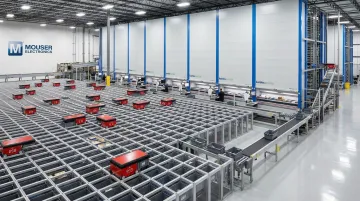
Headquartered in Mansfield, Texas, Mouser Electronics has built its reputation on the "newest products fastest" positioning. The company stocks over 1.2 million SKUs from more than 1,200 manufacturer brands, with aggressive expansion into industrial automation. In 2025, Mouser launched over 40,000 new part numbers and added 63 new manufacturers to their line card, emphasizing innovation-focused suppliers.
Their new product introduction (NPI) model delivers distinct advantages:
- Rapid access to latest components, often within weeks of manufacturer release
- Priority relationships with innovation-focused suppliers
- Comprehensive technical data including CAD models and 3D step files
| Category | Details |
|---|---|
| Automation Innovation Focus | New product introduction (NPI) model ensures automation engineers get early access to emerging technologies. Partnered with ATI Industrial Automation in November 2025 for global distribution of robotic tool changers and force/torque sensors. Added manufacturers specializing in IIoT modules (Telit Cinterion), force sensors (VPG), and other automation-critical components. Emphasis on Industry 4.0 enabling technologies including edge AI modules and industrial 5G connectivity. |
| Global Availability | Distribution network covers North America, Europe, and Asia-Pacific with 25,000 orders shipped daily from their highly automated distribution center. Operates 187 Vertical Lift Modules and 120 AutoStore robots for rapid order fulfillment. Most in-stock automation components ship same-day, with international delivery typically within 2-5 business days depending on destination. |
| Design Resources | Extensive technical documentation including application notes and reference designs; parametric search with industrial-specific filters (IP ratings, temperature ranges, certifications); downloadable CAD models and PCB footprints; technical webinars featuring automation manufacturers; and dedicated industrial automation resource center with solution guides. |
Arrow Electronics
For engineers requiring complete system solutions beyond individual components, Arrow Electronics takes a different approach. Based in Centennial, Colorado, Arrow Electronics operates as a global enterprise-level distributor with a distinct focus on complete automation solutions rather than just component supply. Arrow positions itself as a technology solutions provider, offering IoT platform integration, engineering design services through their eInfochips division, and comprehensive supply chain solutions that extend beyond traditional distribution.
This solutions-focused approach delivers several benefits:
- Engineering design services for custom automation development
- Supply chain optimization including BOM analysis and inventory buffering
- IoT platform integration with "Sensor to Sunset™" approach for multi-vendor implementations
- Complete system architectures rather than just component sales
| Category | Details |
|---|---|
| Automation Solutions Portfolio | Comprehensive industrial IoT solutions including edge computing platforms, industrial gateways, and connectivity modules. Distributes processor control and industrial automation technology from Analog Devices and other major manufacturers. Robotics components including controllers, vision systems, and safety devices. Strong emphasis on complete system architectures rather than individual parts. |
| Value-Added Services | Engineering support through eInfochips for custom automation solution development; supply chain management including demand forecasting and inventory optimization; system integration capabilities that bridge multiple technology domains; BOM optimization services that identify cost savings and alternative components; and technical training programs for customer engineering teams. |
| Enterprise Support | Dedicated account management for large-scale automation deployments; volume pricing structures that scale with project size; global logistics coordination for multi-site rollouts; supplier consolidation services that reduce vendor complexity; and solutions for IIoT implementations requiring 20-25 suppliers, integrated through Arrow's platform approach. |
Avnet
Founded in 1921 and headquartered in Phoenix, Arizona, Avnet is a Fortune 500 distributor with deep expertise in IoT and embedded solutions. The company delivered nearly 240 billion components worldwide in fiscal year 2024, positioning itself as an ecosystem connector that brings suppliers together with automation innovators through technology partnerships and design support programs.
Their ecosystem approach centers on three core strengths:
- IoT partnerships providing complete solution stacks
- Embedded computing expertise across processors, FPGAs, and system-on-modules
- Industry 4.0 technical resources for digital transformation
| Category | Details |
|---|---|
| IoT & Embedded Automation | Specialized offerings for edge AI modules including NVIDIA Jetson platforms and Intel OpenVINO solutions; industrial gateways supporting multiple protocols (MQTT, OPC UA, Modbus); sensor fusion solutions that combine data from multiple sensor types; embedded computing platforms optimized for industrial temperature ranges and long lifecycle support; and comprehensive connectivity options from cellular to industrial Ethernet. |
| Ecosystem & Partnerships | Manufacturer relationships covering semiconductor leaders to specialized automation suppliers; technology partnerships with cloud platform providers (AWS IoT, Azure IoT) for end-to-end solutions; design chain partnerships that connect customers with engineering service providers; AI-powered tools for supply chain optimization and component selection; and innovation programs that provide early access to emerging automation technologies. |
| Technical Support | Design support services including schematic review and component selection assistance; prototyping services with fast-turn PCB assembly; automation-specific technical training programs covering industrial protocols, safety standards, and system architecture; inventory buffering services that provide supply assurance for long-term projects; and lifecycle management support for products requiring extended availability. |
RS Components (Allied Electronics & Automation)
Operating in 36 countries with over 1 million customers worldwide, RS Components (part of RS Group, which includes Allied Electronics & Automation in North America) positions itself as a global industrial distributor with deep automation expertise. The company combines MRO (maintenance, repair, operations) focus with design engineering support, partnering with over 2,500 suppliers to deliver comprehensive industrial product coverage.
Their industrial focus delivers specific benefits:
- Product selection emphasizing reliability and compliance over consumer-grade alternatives
- Maintenance and repair support alongside new design components
- Ideal for facilities managing both legacy systems and new automation projects
| Category | Details |
|---|---|
| Industrial Automation Specialization | Extensive PLC and controller selection from Siemens, Allen-Bradley, Mitsubishi, and other major brands; HMI panels and operator interfaces across multiple sizes and communication protocols; industrial networking equipment including managed switches, media converters, and protocol gateways; safety components certified to international standards (ISO 13849, IEC 62061); and sensor portfolio covering proximity, photoelectric, ultrasonic, and vision technologies. |
| MRO & Lifecycle Support | RS ControlStock® vendor-managed inventory solution for fast-moving maintenance parts; obsolescence management services that identify replacement components for aging automation systems; technical support for troubleshooting existing installations; cross-reference tools that match competitor part numbers to available alternatives; and lifecycle planning assistance for long-term automation platform sustainability. |
| Regional Strengths | Particularly strong presence in Europe and Asia-Pacific with localized inventory and support; regional compliance expertise covering CE marking, UKCA, and other territorial requirements; local language technical support and documentation; same-day shipping from regional distribution centers; and understanding of regional automation standards and preferred manufacturers. |
How We Chose the Best Electronic Component Suppliers for Automation
Many companies make critical mistakes in supplier selection. They focus exclusively on price while overlooking total cost of ownership. They underestimate the value of technical support when integrating complex automation systems. Or they choose general-purpose distributors without automation-specific expertise in industrial protocols, safety standards, or environmental requirements.
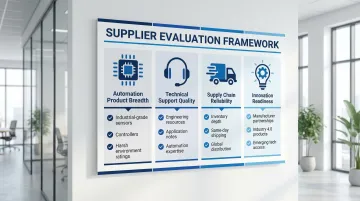
To avoid these pitfalls, our evaluation framework prioritized four key areas:
- Automation product breadth – Industrial-grade sensors, controllers, and networking equipment designed for harsh environments, not just general electronic components
- Technical support quality – Engineering resources, application notes, and staff expertise in automation technologies
- Supply chain reliability – Inventory depth, lead time performance, and geographic distribution capabilities
- Innovation readiness – Direct manufacturer partnerships, Industry 4.0 product lines, and measurable investment in new automation technologies
We considered these specific factors:
- Availability of both current-generation and legacy automation components for long-term system support
- Ability to ship in-stock items same-day and provide realistic timelines for sourced components
- ISO 9001 for quality management, AS9120 for aerospace/defense applications, and ESD compliance for sensitive component handling
- Technical staff who understand industrial automation, not just general electronics
- Relationships with automation manufacturers that provide early access to new technologies and direct technical support channels
Conclusion
The right component supplier functions as a strategic partner in automation innovation, not merely a parts source. Leading distributors deliver three critical advantages:
- Faster time-to-market through extensive inventory and same-day shipping
- Access to emerging technologies via manufacturer partnerships and NPI programs
- Technical expertise that helps navigate automation requirements from safety certifications to protocol compatibility
Evaluate suppliers on these automation-specific capabilities:
- Industrial product knowledge and environmental ratings
- Technical support depth with staff who understand your application requirements
- Supply chain resilience through robust inventory management and global sourcing networks
Don't focus solely on catalog size or unit pricing.
Comprehensive component procurement requires global sourcing capabilities and rigorous quality standards. LEVEL SOLUTIONS provides access to millions of components for automation projects, with ESD-compliant warehouse handling and both commercial and mil-spec options to meet your specific requirements.
Frequently Asked Questions
What are the most popular electronic components?
The most common categories include semiconductors (microcontrollers, processors, memory), passive components (resistors, capacitors, inductors), connectors, sensors, and power management ICs. Semiconductors alone represent 46.4% of Americas distribution market share.
What components are essential for automation systems?
Essential components include PLCs for control logic, sensors (proximity, photoelectric, vision) for detection, actuators and motor drives for movement, HMIs for operator interfaces, and industrial communication modules supporting EtherCAT and PROFINET protocols.
How do I choose between authorized distributors and brokers for automation components?
Authorized distributors maintain formal manufacturer agreements, offering genuine products with warranties and technical support. Brokers help source hard-to-find parts but lack warranties and carry higher counterfeit risk—making authorized distributors essential for mission-critical automation.
What certifications should automation component suppliers have?
Key certifications include ISO 9001 for quality management, ANSI/ESD S20.20 for electrostatic discharge protection, AS9120 for aerospace/defense with counterfeit prevention, and AS6081 for source reliability. Industry-specific needs vary—aerospace requires AS9100, automotive may require IATF 16949.
How long does it take to source automation components in 2025?
Lead times have stabilized for general-purpose components, with common automation parts shipping same-day or within days. Specialized components may require 2-4 weeks, while AI-related and high-performance computing parts face extended lead times due to demand.
What's the difference between component manufacturers and distributors?
Manufacturers design and produce components (Siemens, Schneider Electric, Omron develop PLCs, sensors, drives). Distributors aggregate products from multiple manufacturers, maintain inventory for immediate availability, and provide technical support—giving customers access to thousands of manufacturers through one relationship.