Introduction
Procurement teams face a troubling reality: in 2024, counterfeit component reporting surged by 25%, according to industry data. The pattern has shifted—active, readily available parts are now targeted more than twice as often as long-lead-time components, shattering the assumption that "available" means "safe."
The risks extend beyond counterfeits. Industry reports indicate that 30% of End-of-Life notices were issued without Product Change Notifications in 2023, leaving manufacturers blindsided by sudden shortages. Combined with geopolitical disruptions and price volatility, these challenges have transformed component sourcing from a transactional purchasing function into a strategic imperative.
Modern electronic component sourcing requires sophisticated supply chain intelligence, multi-tier supplier networks, and technology-enabled verification. This guide explores how businesses can build resilient sourcing strategies that protect against these evolving threats while maintaining production continuity.
TLDR: Key Takeaways for Smart Electronic Component Sourcing
- Diversify supplier networks across authorized distributors and qualified independents to eliminate single points of failure
- Rigorous authentication protocols combat the 25% surge in counterfeit components affecting supply chains
- E-procurement platforms reduce transaction times by up to 80% while providing real-time inventory visibility
- Total Cost of Ownership extends beyond unit price—quality risks and lead times hide $20-50M in expenses
- Qualify alternate components during development to avoid costly end-of-life purchases and reactive sourcing
Understanding Modern Supply Chain Challenges in Component Procurement
Electronic component procurement has evolved from straightforward ordering to navigating a landscape of structural volatility. Global lead times for discrete components improved from crisis-era peaks of 26+ weeks to approximately 14 weeks by late 2024, yet specific categories remain constrained.
The market shows dramatic variation by component type. Analog ICs saw lead times decrease by 18% to around 23 weeks, and discrete semiconductors improved from 25-43 weeks to 10-16 weeks. However, AI-centric products, EV power electronics, and high-capacitance MLCCs still face lead times extending to 28 weeks, creating a split market where general availability masks persistent allocation challenges.
Price volatility has shifted dramatically. The semiconductor market transitioned from tremendous growth to cyclical downturn starting in mid-2022, with distributor revenues dropping 9.3% in 2024. The Gartner Index moved into "moderate surplus" territory by Q1 2024, signaling a buyer's market for many commodities—yet strategic components remain tightly allocated.
Geopolitical factors now drive availability as much as supply and demand. The US implemented export controls in October 2022 that restrict China's ability to purchase and manufacture high-end chips, creating bifurcation in supply chains for dual-use technologies.
Regional concentration risks persist despite diversification efforts. Vietnam doubled its electronics exports to the US between 2017 and 2022, but qualifying new regional supply hubs takes time and resources.
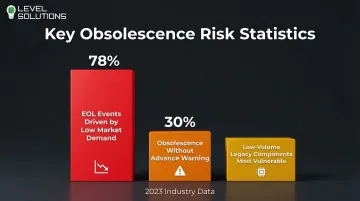
The "silent" obsolescence threat poses hidden risks. Total obsolescence events decreased 37% from 756,087 parts in 2022 to 473,910 in 2023, yet a staggering 30% (142,173 parts) went End-of-Life (EOL) without Product Change Notifications.
Key obsolescence risks include:
- 78% of EOL events driven by low market demand, not technological upgrades
- Low-volume legacy components particularly vulnerable to sudden discontinuation
- 30% of obsolescence occurs without advance warning to procurement teams
Strategic Sourcing Approaches for Component Procurement
Diversifying Your Supplier Base
Multi-tier supplier networks eliminate single points of failure. Work with:
- Authorized distributors for lowest-risk procurement with full traceability and manufacturer warranties
- Franchised partners offering technical support and allocation access during shortages
- Verified independent distributors for hard-to-find and obsolete components requiring rigorous qualification
Geographic diversification reduces localized disruptions. The "China+1" strategy is reshaping supply chains, with manufacturers actively qualifying suppliers in Southeast Asia and Mexico.
Mexico benefits from nearshoring for automotive and appliance electronics, offering shorter logistics loops for North American OEMs. This regional approach works best when paired with ESD-compliant warehouse facilities for immediate availability and global sourcing networks for comprehensive component access.
Design for Sourcing Flexibility
Supplier diversity means little if your designs can't adapt. Engineering teams must integrate supply chain intelligence during design phases.
Define Form-Fit-Function alternatives early in development cycles to avoid costly redesigns when components become unavailable. The US Air Force reported $1.2 billion in cost avoidance between 2012 and 2021 by implementing proactive strategies—including lifetime buys and phased redesigns—rather than reacting to obsolescence after the fact.
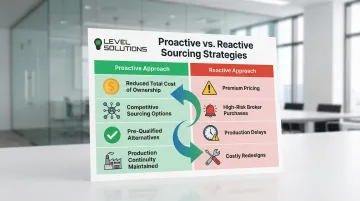
Proactive qualification delivers measurable advantages:
- Reduces Total Cost of Ownership through competitive sourcing
- Eliminates high-risk broker purchases during shortages
- Maintains production continuity with pre-qualified alternatives
- Avoids premium pricing from last-minute substitutions
Proactive vs. Reactive Sourcing
Reactive sourcing responds to shortages with expedited orders, premium pricing, and increased counterfeit risk. Proactive strategies include:
- Demand forecasting based on historical usage and market intelligence
- Strategic inventory positioning for critical components
- Long-term supplier agreements securing allocation during tight markets
- Early engagement with suppliers during design phase for lead-time-sensitive parts
Strategic Inventory Management
Static safety stock models cost manufacturers $20-50 million in excess inventory for typical $500 million supply chains. Dynamic optimization adjusts buffer levels based on real-time demand signals and supplier performance, reducing inventory holdings by 15-30% while improving service levels.
Buffer stock strategies work best for critical components with long lead times or single-source dependencies. Just-in-time approaches suit commodity parts with multiple suppliers and stable availability. Calculate optimal inventory levels by factoring lead times, usage rates, demand variability, and supply risk profiles—not arbitrary "days of supply" targets.
Leveraging Global and Local Resources
Combining global sourcing networks with local warehousing creates balanced supply chains. Global networks provide access to specialized components, obsolete parts, and volume pricing. Local warehousing—particularly ESD-compliant facilities—delivers immediate availability, reduced shipping times, and proper component storage that maintains integrity for sensitive semiconductors and precision passives.
Building a Resilient Multi-Tier Supply Network
Understanding Supplier Tiers and Relationships
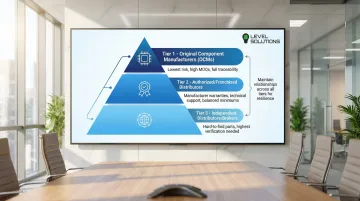
Tier 1 (Original Component Manufacturers): Own intellectual property and manufacturing rights. Direct sourcing offers lowest risk and full traceability but requires high minimum order quantities.
Tier 2 (Authorized/Franchised Distributors): Maintain contractual agreements with OCMs, adhere to strict quality controls, offer manufacturer warranties, and provide technical support. These represent the primary channel for secure sourcing with balanced minimums and lead times.
Tier 3 (Independent Distributors/Brokers): Operate without OCM contracts, sourcing from open markets including overstock and secondary channels. Essential for hard-to-find parts but carry highest counterfeit risk, requiring rigorous verification.
Maintain relationships across multiple tiers. Authorized distributors provide security for production components, while qualified independents offer solutions for obsolescence and allocation challenges.
Supplier Qualification and Performance Monitoring
Evaluate new suppliers against rigorous criteria:
- ISO 9001:2015 certification for baseline quality management systems
- AS9120B certification for aerospace distributors (adds traceability and chain-of-custody requirements)
- AS6081 compliance for independent distributors (counterfeit avoidance and detection)
- Financial stability verified through credit reports and business references
- Track record confirmation through industry databases like ERAI and GIDEP
Implement ongoing performance scorecards tracking Product Quality Rate (percentage of defect-free units) and On-Time Delivery. These metrics objectively measure supplier reliability. Conduct regular audits of supplier facilities, quality systems, and documentation practices.
Building Strategic Partnerships
Beyond transactional relationships, strategic partnerships with key suppliers provide competitive advantages during market constraints.
Develop these collaborations through:
- Information sharing on forecasts and design roadmaps
- Joint planning for capacity and allocation
- Long-term volume commitments in exchange for pricing stability
- Preferred supplier programs securing allocation during shortages
When markets tighten, these partnerships ensure your production lines receive priority allocation.
Risk Assessment and Contingency Planning
Proactive risk management starts with identifying supply chain vulnerabilities:
- Single-source dependencies for critical components
- Geographic concentration (all suppliers in one region)
- Financial instability of key suppliers
- Technology transitions making current components obsolete
Develop contingency plans including qualified secondary sources, safety stock for high-risk parts, and alternative designs. Activate these alternatives when primary components become unavailable. Review and update risk assessments quarterly as market conditions evolve.
Managing Mil-Spec and Specialized Component Requirements
Military-grade components require specific certifications and complete traceability. The Defense Logistics Agency manages the Qualified Suppliers List of Distributors (QSLD) program for military semiconductors and microcircuits.
QSLD vendor sourcing serves as a primary mitigation strategy for defense procurement.
Level Solutions provides comprehensive coverage for both commercial and military-specification components across all manufacturers and package types, maintaining ESD-compliant storage for sensitive mil-spec parts requiring stringent handling protocols.
Quality Assurance and Counterfeit Prevention
The Counterfeit Component Threat
Counterfeit electronics represent a $250 billion annual global impact, posing severe safety risks to critical infrastructure and defense systems.
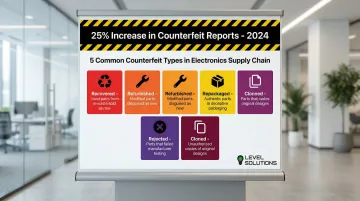
In 2024, ERAI reported 1,055 suspect counterfeit and nonconforming parts—a 25% increase over 2023 and the highest level since 2015. The threat has evolved dangerously: active, readily available components accounted for 27.2% of reported incidents in 2024, appearing more than twice as often as long-lead-time parts.
Counterfeiters exploit the false assumption that "available" means "safe." Authentication is now essential even for common components.
Common counterfeit types include:
- Recovered: Used parts from e-waste sold as new
- Refurbished: Modified parts disguised as new
- Repackaged: Authentic parts in deceptive packaging
- Rejected: Parts that failed manufacturer testing
- Cloned: Unauthorized copies of original designs
A documented case involved an operational amplifier marked as Analog Devices that actually contained a voltage reference die from a different manufacturer—a substitution that could cause catastrophic system failures.
Supplier Verification and Due Diligence
Red flags indicating high counterfeit risk:
- Prices significantly below market rates
- Lack of quality certifications (ISO 9001, AS6081)
- Unwillingness to provide certificates of conformance
- Vague or incomplete traceability documentation
- Recently established businesses with limited track records
These warning signs indicate elevated risk, but verification goes beyond spotting red flags.
Work only with verified suppliers through legitimate marketplaces. Check industry databases including ERAI (Electronic Resellers Association International) and GIDEP (Government-Industry Data Exchange Program) for reported incidents before placing orders.
Component Authentication Methods
Implement multi-layered inspection following SAE AS6171 Test Methods Standard:
Supplier certifications matter because they demonstrate commitment to systematic quality controls, traceability, and continuous improvement.
When evaluating component sources, look for distributors with ESD-compliant warehouse facilities that ensure component integrity throughout storage and fulfillment. Level Solutions maintains these quality standards alongside comprehensive inspection protocols that exceed industry benchmarks.
Technology-Enabled Sourcing Solutions
E-Procurement Platforms and Online Marketplaces
E-procurement platforms automate purchasing by connecting buyers directly to supplier inventories through web interfaces or API integrations. These systems provide instant access to pricing, availability, and lead times—eliminating manual processes that slow down procurement cycles.
Industry adoption is accelerating. Digital procurement systems are projected to grow at 7.3% CAGR through 2025 as manufacturers discover measurable efficiency gains.
Specialized electronic component marketplaces differ from general e-commerce sites in critical ways. They verify suppliers, maintain quality standards, and aggregate inventory from authorized sources only.
This specialization reduces counterfeit risk while enabling instant price comparison across multiple distributors—no phone calls or email exchanges required.
Implementing e-procurement platforms can reduce transaction times by up to 80% compared to manual processes, freeing procurement staff for strategic tasks like supplier relationship management and risk mitigation.
API Integration and ERP Connectivity
API integrations connect your ERP system directly to distributor inventories, providing real-time stock levels, pricing, and lead times. This connectivity automates order placement, eliminates manual entry errors, and cuts cycle times from requisition to delivery.
Direct API connectivity with major distributors like Arrow, Digi-Key, and others eliminates phone calls and email exchanges for routine orders. Automated quoting systems return pricing and availability instantly, allowing procurement teams to make informed decisions without delays.
Modern e-procurement platforms also enable sophisticated supplier management and global sourcing strategies. Companies like LEVEL SOLUTIONS leverage these systems to provide customers access to billions of components worldwide while maintaining local inventory for immediate shipment.
Data Analytics and Supply Chain Intelligence
Beyond automation, today's sourcing platforms incorporate predictive capabilities that transform how procurement teams operate.
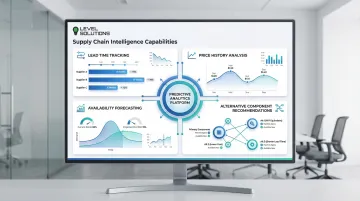
Advanced analytics identify patterns in supplier data, forecast demand, and predict price trends. These tools shift procurement from reactive ordering to strategic planning.
Key capabilities include:
- Lead time tracking across suppliers and component categories
- Price history analysis identifying optimal buying windows
- Availability forecasting based on market trends and manufacturer capacity
- Alternative component recommendations based on Form-Fit-Function equivalence
This intelligence reduces costs and improves supply chain resilience by anticipating shortages before they impact production.
Optimizing Costs While Maintaining Quality Standards
Total Cost of Ownership vs. Unit Price
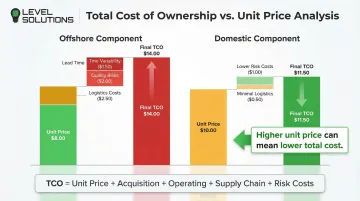
The lowest unit price rarely delivers the best value. Total Cost of Ownership includes:
- Acquisition costs: Unit price, freight, tariffs, payment terms
- Operating costs: Incoming inspection, testing, compliance documentation
- Supply chain costs: Inventory carrying costs, expedited shipping, minimum order quantities
- Risk costs: Quality failures, production delays, warranty claims, counterfeit exposure
Consider this example: a lower-cost offshore component at $8.00 may have a TCO of $14.00 once you factor in logistics, quality risks, and lead time variability. That's higher than a domestic alternative at $10.00 with a TCO of $11.50.
Calculate TCO for strategic components to make informed sourcing decisions.
Strategic Timing and Market Awareness
Beyond calculating TCO, smart buyers time their purchases to market conditions.
Semiconductor markets follow cyclical patterns between shortage and surplus conditions. The 2024 shift to "moderate surplus" presents cost optimization opportunities for standard components. Buyers have more leverage to negotiate pricing and terms when inventory pressure eases.
Monitor component pricing trends and lead time indicators to time purchases strategically. Surplus periods are ideal for buying components with stable demand and long shelf life. Strategic inventory and qualified alternatives help you avoid panic buying during shortages.
Volume Leverage and Consolidation
Volume gives you negotiating power. Consolidating purchases with fewer strategic suppliers improves pricing through volume discounts. However, consolidation increases supply chain fragility by creating dependencies.
Balance consolidation for cost savings with diversification for risk mitigation.
Strategic approach:
- Consolidate spend for commodity components with multiple sources
- Diversify critical components across geographic regions and supplier tiers
- Negotiate volume agreements that include allocation guarantees during shortages
When consolidating volume, work with suppliers who can deliver across multiple component categories. Level Solutions provides volume discounts and flexible payment terms for consolidated purchases spanning memory, logic, analog, processors, passives, and connectors—streamlining your procurement while maintaining competitive pricing.
Frequently Asked Questions
What are e-procurement solutions?
E-procurement solutions are digital platforms that automate purchasing processes for electronic components, providing real-time access to supplier inventories, pricing, and lead times through API integrations that connect directly to ERP systems.
What are the 7 steps of sourcing?
The sourcing process includes: identifying component needs, supplier research and qualification, request for quotation, supplier evaluation, negotiation, purchase order placement, and ongoing performance monitoring.
How do you verify the authenticity of electronic components?
Verify authenticity through supplier due diligence and certification checks, certificate of conformance review, external visual inspection, and third-party testing including X-ray analysis and decapsulation for high-risk components.
What is the difference between authorized and independent distributors?
Authorized distributors have direct manufacturer contracts and sell only new, genuine parts with full traceability. Independent distributors operate in secondary markets without manufacturer relationships, requiring more rigorous verification.
How long does it typically take to source hard-to-find components?
Timelines vary widely: same-day shipping for in-stock items at local warehouses, 10-16 weeks for current production semiconductors, or several months for allocated or obsolete parts requiring global searches.
What are the biggest risks in global component sourcing?
Primary risks include counterfeit parts (up 25% in 2024), supply chain disruptions from geopolitical tensions, quality inconsistencies from unverified suppliers, extended lead times, and sudden obsolescence events (30% without prior notification in 2023).