Electronic components typically represent 40-60% of total product cost, making sourcing strategy one of the most significant levers for controlling manufacturing economics. Yet the landscape has grown increasingly complex: advanced memory lead times now stretch beyond 40 weeks due to AI-driven demand, while 750,000 components were declared End-of-Life in 2022 alone—a 50% jump from the previous year. Simultaneously, counterfeit incidents rose 25% in 2024, with authentic-looking fakes infiltrating even authorized channels.
This guide provides a comprehensive framework for building resilient component sourcing operations—from developing strategic procurement plans to selecting reliable suppliers, ensuring quality compliance, and managing supply chain risks that threaten production continuity.
TLDR
- Components represent 40-60% of product cost, making sourcing critical to profitability and time-to-market
- Lead times have split: passives stabilized at ≤4 weeks while advanced memory exceeds 40 weeks
- Authorized distributors control ~90% of global distribution revenue and minimize counterfeit risk
- 475,000+ parts reach EOL annually, requiring multi-sourcing and lifecycle planning
- Quality standards like AS6081 and ESD compliance protect against counterfeit components
Understanding Electronic Component Sourcing
What Component Sourcing Entails
Electronic component sourcing covers the complete process of identifying, evaluating, procuring, and managing the supply of parts needed for manufacturing. This spans passive components like resistors and capacitors, active components including ICs and processors, and electromechanical parts such as connectors and switches.
Effective sourcing requires more than placing purchase orders. It involves analyzing technical specifications, evaluating supplier reliability, and negotiating commercial terms.
The process also includes verifying component authenticity, managing inventory levels, and maintaining supply continuity throughout the product lifecycle.
Why Strategic Sourcing Matters
Component costs dominate product economics. In 2024, semiconductors alone represented 79.3% of worldwide authorized distribution revenue, making chip pricing the primary cost driver in most electronics BOMs. A 5% improvement in component costs can translate to millions in savings for high-volume products.
Beyond cost, sourcing decisions directly impact:
- Time-to-market: Long lead times or allocation shortages delay product launches
- Product quality: Counterfeit or substandard components cause field failures
- Supply chain resilience: Single-source dependencies create vulnerability to disruptions
- Regulatory compliance: Non-compliant components trigger costly redesigns and recalls
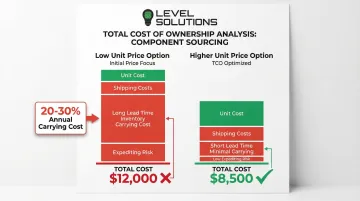
Inventory carrying costs typically represent 20-30% of total inventory value annually, while stockouts halt production lines and incur expediting fees that far exceed the original component cost.
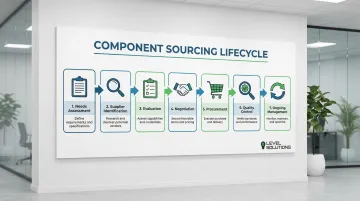
The Component Sourcing Lifecycle
Sourcing evolves through distinct phases:
- Needs assessment - Analyze BOM requirements, specifications, and quantities
- Supplier identification - Research potential sources across distributors, manufacturers, and specialized suppliers
- Evaluation - Assess pricing, availability, quality track record, and compliance
- Negotiation - Secure favorable terms on pricing, lead times, and minimum quantities
- Procurement - Place orders and manage inbound logistics
- Quality control - Verify authenticity and test incoming components
- Ongoing management - Monitor supplier performance and adapt to changing conditions
Requirements shift dramatically from prototype to production. Prototyping demands flexibility and fast turnaround with small quantities. Production requires cost optimization, supply guarantees, and long-term availability commitments.
Key Stakeholders in the Sourcing Process
Successful sourcing requires cross-functional collaboration:
- Design engineers specify components and evaluate alternatives
- Procurement teams negotiate contracts and manage supplier relationships
- Supply chain managers forecast demand and optimize inventory
- Quality assurance establishes standards and verifies incoming parts
- Manufacturing provides feedback on component performance and assembly issues
Cross-functional alignment prevents costly downstream problems. Without it, engineers may select components without checking availability. Procurement might optimize cost without considering quality implications. Manufacturing may discover assembly issues too late to change components economically.
Developing a Sourcing Strategy
Assessing Your Sourcing Needs
Start by analyzing your Bill of Materials (BOM) to understand component requirements in detail. Document specifications, required quantities, acceptable alternatives, and criticality to production. Focus strategic effort on parts that represent high cost, long lead times, single-source risk, or production criticality.
Forecast demand across product lifecycle stages.
Prototype runs require small quantities with fast turnaround. Initial production needs moderate volumes with flexibility for design changes. Full production demands cost optimization and supply guarantees. End-of-life phases require last-time buys and transition planning.
Identify critical components requiring special attention:
- Parts with lead times exceeding your production cycle
- Single-source components with no qualified alternatives
- High-value items representing significant cost exposure
- Components approaching obsolescence
- Parts with quality or compliance risks
Choosing Between Sourcing Approaches
Single-sourcing vs. multi-sourcing represents a fundamental strategic choice:
Single-sourcing concentrates volume with one supplier, maximizing leverage for pricing and allocation priority. This simplifies logistics and supplier management.
The tradeoff is vulnerability. Any disruption to that single source halts production.
Multi-sourcing qualifies multiple suppliers for the same component, providing redundancy and competitive pressure. This builds resilience but requires more complex management and may sacrifice volume leverage.
For critical components, multi-sourcing is essential despite the overhead.
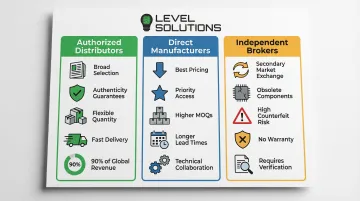
Authorized distributors vs. manufacturers vs. brokers serve different needs:
Authorized distributors:
- Broad selection with authenticity guarantees
- Flexible quantities and fast delivery
- Ideal for prototyping and low-to-medium volumes
- Top 50 distributors account for ~90% of global authorized distribution revenue
Direct manufacturer relationships:
- Best pricing for high volumes
- Priority access during shortages
- Technical collaboration opportunities
- Higher minimum order quantities and longer lead times
Independent distributors (brokers):
- Source from secondary markets outside authorized channels
- Use only for obsolete parts or allocation emergencies
- Require rigorous verification—counterfeit risk is substantially higher
Planning for Component Lifecycle Management
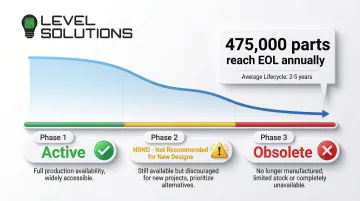
Components now remain in production for only two to five years on average before manufacturers declare them End-of-Life. With 475,000 parts reaching EOL annually, lifecycle management has become critical for products with 10+ year lifecycles.
Track component lifecycle status continuously:
- Active: Currently in production with no EOL announced
- NRND (Not Recommended for New Designs): Still available but manufacturer discourages new designs
- Obsolete: No longer manufactured; available only through remaining inventory
Plan for obsolescence proactively. Select components with long lifecycle expectations during design. Monitor manufacturer PCNs (Product Change Notifications) and EOL announcements. Identify and qualify alternate components before the original becomes unavailable. For long-lifecycle products, consider last-time buys to secure inventory through the product's remaining life.
Establishing Budget and Cost Targets
Set realistic cost targets based on market research, volume requirements, and competitive benchmarks. Consider total cost of ownership beyond unit price:
- Component unit cost at your volume tier
- Shipping and freight charges
- Import duties and taxes
- Quality testing and inspection costs
- Inventory carrying costs
- Risk costs (expediting fees, production delays, warranty claims)
A component with 10% lower unit price but 40-week lead time may cost more total than a slightly pricier alternative available immediately when you factor in inventory carrying costs and production flexibility.
Where to Source Electronic Components
Authorized Distributors
Major distributors like Digi-Key, Mouser, Arrow, and Avnet serve as the primary channel for most component purchases.
These authorized partners maintain direct agreements with component manufacturers, ensuring authenticity and providing comprehensive support.
Key advantages include:
- Authenticity guarantees backed by manufacturer relationships
- Broad component selection across thousands of manufacturers
- Technical support and extensive design resources
- Flexible order quantities from single units to production volumes
- Fast delivery with same-day shipping options
Digi-Key added 1.6 million+ products in 2025 alone, demonstrating the breadth available through major distributors.
Authorized distributors work best for prototyping, low-to-medium volume production, situations requiring component variety, and when fast turnaround matters more than minimum cost.
Direct from Manufacturers
Sourcing directly from component manufacturers makes sense for high-volume production, strategic components, and cost optimization.
Direct relationships offer several advantages: best pricing, allocation priority during shortages, technical collaboration on design optimization, and long-term supply agreements.
Direct sourcing does come with tradeoffs:
- Higher minimum order quantities (often thousands or tens of thousands of units)
- Longer lead times compared to distributors
- Relationship requirements and account setup
- Volume thresholds that exclude smaller buyers
Manufacturers typically won't engage for small volumes—you need significant purchasing power to justify their direct attention.
Specialized Component Suppliers
Niche suppliers focus on specific component categories or market segments, often providing deeper expertise and better availability than broad-line distributors. Examples include RF component specialists, power electronics experts, and connector-focused suppliers.
Level Solutions represents this category with ESD-compliant warehouses stocking millions of components for immediate shipment, plus access to billions of parts through global sourcing networks. Specialized partners like this combine local inventory for fast turnaround with worldwide reach for hard-to-find components.
Online Marketplaces and Aggregators
Platforms like Octopart and Findchips aggregate pricing and availability data across multiple suppliers, enabling rapid comparison shopping. These tools help identify the best combination of price, availability, and lead time without manually checking each distributor.
Keep limitations in mind: inventory data can lag behind real-time availability, and these platforms can't verify component authenticity. Always verify critical information directly with suppliers before placing orders, and use aggregators as research tools rather than sole decision-making sources.
Contract Manufacturers and EMS Providers
Contract manufacturers (CMs) can handle component sourcing as part of turnkey manufacturing services.
The convenience is clear: you leverage their purchasing power across multiple customers. However, you sacrifice some direct control, pay markup on components, and risk potential conflicts if the CM prioritizes their interests over yours.
Retain sourcing control for strategic components where you need direct supplier relationships, allocation priority, or proprietary designs. Delegate commodity components to CMs where their volume leverage provides better economics than you can achieve independently.
Component Selection Criteria
Technical Specifications and Performance
Verify components meet all electrical, mechanical, thermal, and environmental specifications for your application. Review datasheets thoroughly, checking parameters like operating voltage ranges, current ratings, temperature tolerances, and package dimensions.
Use parametric search tools offered by major distributors to filter components by specifications. Define your requirements—voltage regulator, 3.3V output, 1A current, SOT-23 package—and instantly see matching parts from multiple manufacturers.
Key parameters to verify:
- Operating voltage ranges and current ratings
- Temperature tolerances (operating and storage)
- Package dimensions and footprint compatibility
- Power dissipation and thermal characteristics
- Signal integrity specifications (rise time, noise margins)
Availability and Lead Times
Lead times vary dramatically by component type. Passive components have stabilized at ≤4 weeks, while advanced memory (DDR4/DDR5) now requires over 40 weeks due to AI server demand. Check lead times across multiple suppliers—availability often varies significantly.
Assess lifecycle status before committing to a component. Parts already marked NRND (Not Recommended for New Designs) create future obsolescence risk. For long-lifecycle products, prioritize components with strong availability and manufacturer commitment to continued production.
Cost and Total Cost of Ownership
Evaluate component pricing across volume tiers and multiple suppliers. Unit cost typically decreases at volume breakpoints—understanding these thresholds helps optimize order quantities.
Look beyond unit price to total cost:
- Shipping costs and delivery speed
- Import duties and taxes
- Minimum order quantities (MOQs) that increase inventory holding costs
- Payment terms (net-30 vs. prepayment)
- Testing and quality assurance expenses
- Inventory carrying costs for long-lead-time parts
A component with 15% lower unit price but 30-week lead time may cost more overall than a pricier alternative available in two weeks—inventory carrying costs run 20-30% annually.
Quality Assurance and Compliance
Authenticating Components and Preventing Counterfeits
Counterfeit incidents rose 25% in 2024, reaching a nine-year high. Surprisingly, 62.2% of reported suspect parts were "active" components, debunking the myth that only obsolete parts are targeted.
Best practices for preventing counterfeits:
- Purchase exclusively from authorized distributors for production volumes
- Inspect packaging and markings for inconsistencies
- Verify date codes and lot numbers with manufacturer databases
- Use third-party testing services (X-ray, decapsulation, XRF analysis) when sourcing from non-authorized channels
- Require AS6081 compliance from any independent distributors
- Maintain chain-of-custody documentation
Beyond component failure, counterfeit parts create liability exposure, regulatory violations, and warranty claims that far exceed any initial cost savings.
Regulatory Compliance Requirements
Key regulations vary by region and industry:
- RoHS (Restriction of Hazardous Substances): Restricts 10 hazardous materials including lead, mercury, and cadmium in EU electronic equipment. Verify supplier Certificates of Conformity and material declarations
- REACH: Requires notification if Substances of Very High Concern exceed 0.1% by weight. Suppliers must provide SCIP database documentation for regulated substances
- Conflict Minerals: Mandates due diligence for tin, tantalum, tungsten, and gold sourced from high-risk areas. US-listed companies must file annual disclosures
Maintain compliance documentation for audits and customer requirements. Non-compliance triggers costly redesigns, product recalls, and market access restrictions.
Quality Standards and Certifications
Relevant quality standards include:
- ISO 9001: Baseline quality management system for all suppliers
- IATF 16949: Mandatory for automotive suppliers with strict PPAP requirements
- AS9100: Aerospace standard requiring rigorous quality flow-down
- ISO 13485: Medical device quality management
Evaluate supplier quality management systems, performance history, and certification status before qualification. Look for providers with both commercial and mil-spec capabilities across multiple manufacturers.
Risk Management in Component Sourcing
Identifying and Assessing Supply Chain Risks
Common risks include:
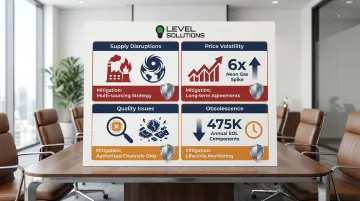
- Supply disruptions: Factory fires, natural disasters, geopolitical conflicts
- Price volatility: The Russia-Ukraine war caused a 6x spike in semiconductor-grade neon gas prices
- Quality issues: Counterfeit parts, manufacturing defects, specification drift
- Obsolescence: Accelerating EOL cycles as technology advances
- Allocation shortages: AI demand pushing memory lead times to 40+ weeks
These risks require systematic assessment for every critical component. Evaluate single-source dependencies, geographic concentration, supplier financial stability, and market dynamics affecting availability.
Supply chain vulnerability becomes clear when examining recent disruptions:
- Renesas factory fire (2021) worsened automotive chip shortages
- Yantian Port lockdown (2021) created massive logistics delays
- AI memory squeeze (2025-2026) pushed DRAM lead times beyond 40 weeks
Mitigation Strategies
Multi-sourcing qualifies at least two manufacturers for every critical component, preventing single-source bottlenecks. The resilience gained justifies the overhead of managing multiple sources.
Strategic inventory management maintains safety stock for high-risk components. Hold 12 weeks or more of inventory for long-lead-time parts like advanced memory.
Consider consignment arrangements or vendor-managed inventory to reduce capital tied up in stock.
Long-term supply agreements (LTAs) provide another layer of protection. These contracts reserve fab capacity rather than just ordering specific part numbers, guaranteeing allocation during shortages.
Building Supply Chain Resilience
Implement supply chain visibility tools that provide real-time monitoring of inventory levels, lead times, and supplier performance. API connections with major distributors enable automated tracking.
Develop contingency plans:
- Identify alternate sources before shortages hit
- Qualify backup components during design phase, not crisis mode
- Build relationships with multiple suppliers even when concentrating volume
- Geographic diversification reduces regional concentration risk
Balance efficiency and resilience. Just-in-time inventory minimizes carrying costs but creates vulnerability. Buffer stock for critical components provides insurance against disruptions.
Building Strong Supplier Relationships
Supplier Evaluation and Selection
Evaluate potential suppliers across multiple dimensions:
- Quality track record: Defect rates, certifications, audit results
- Financial stability: Credit ratings, years in business, ownership structure
- Technical capabilities: Product knowledge, design support, testing resources
- Responsiveness: Communication quality, problem-solving approach
- Geographic coverage: Locations, logistics capabilities, regional support
Once you've identified promising candidates, dig deeper through on-site audits for strategic partners. Check references and past performance with other customers.
Target suppliers achieving >95% on-time delivery and <100 PPM defect rates.
Negotiation Best Practices
Before entering negotiations, prepare thoroughly by understanding current market conditions and pricing trends. Have qualified alternatives identified to strengthen your position, know your volume commitments and growth projections, and define your priorities beyond just price.
Negotiate multiple factors:
- Payment terms (net-30, net-60, early payment discounts)
- Lead times and expediting options
- Minimum order quantities and flexibility
- Return policies and warranty terms
- Technical support and design resources
Create win-win agreements that support long-term relationships rather than getting maximum short-term savings.
Suppliers who profit reasonably from your business will prioritize your needs during shortages.
Ongoing Supplier Management
Strong relationships don't end at contract signing—they require ongoing attention. Monitor supplier performance using scorecards tracking:
- On-time delivery rate (target ≥95%)
- Quality defect rate (target ≤100 PPM)
- Lead time variance (target ≤20% deviation)
- Responsiveness to inquiries
- Problem resolution effectiveness
Conduct quarterly business reviews with strategic suppliers. Provide feedback on performance, discuss upcoming requirements, and address issues constructively.
Regular communication builds relationships that pay dividends during crises.
Address performance issues directly but professionally. Work collaboratively to identify root causes and implement corrective actions.
Change suppliers only after good-faith efforts to improve have failed. Switching costs are high and new suppliers bring unknown risks.
Frequently Asked Questions
What is the best sourcing strategy?
Balance multiple approaches: use authorized distributors for reliability, establish direct manufacturer relationships for high-volume parts, implement multi-sourcing for critical components, and plan proactively for the 475,000+ annual EOL notices. Adapt your strategy based on component criticality, volumes, and risk tolerance.
What are the 7 components of supply chain management?
The seven components are: planning (forecasting), sourcing (procurement), manufacturing (execution), delivery (logistics), returns (reverse logistics), enabling (technology infrastructure), and continuous improvement (optimization). Sourcing connects planning to manufacturing in this framework.
How do I verify component authenticity?
Purchase from authorized distributors whenever possible. Inspect packaging for inconsistencies, verify date codes with manufacturer databases, and require AS6081 compliance from independent distributors. For high-risk situations, use ISO 17025 accredited labs for X-ray inspection and XRF analysis.
What's the difference between authorized distributors and brokers?
Authorized distributors have direct manufacturer agreements, ensuring authentic parts with full warranty and technical support. Brokers source from secondary markets independently, useful for obsolete parts but carrying higher counterfeit risk with no manufacturer warranty.
How far in advance should I start sourcing components?
Start 3-6 months before production for standard components, or 6-12+ months for long lead time parts like advanced memory (now exceeding 40 weeks). Early engagement enables better pricing, qualification testing time, and buffers for unexpected delays.
When should I consider multi-sourcing?
Consider multi-sourcing for high-volume production where shortages halt output, components with known supply risk, products with long lifecycles, and any part whose unavailability stops production. The qualification overhead is justified by resilience against supply disruptions.