

Introduction
Automotive memory solutions—including DRAM, NAND flash, and LPDDR—are essential components in modern vehicles, powering everything from infotainment systems to advanced driver assistance systems (ADAS) and autonomous driving platforms.
As vehicles evolve into software-defined machines, memory content per vehicle is skyrocketing.
The first quarter of 2026 marked a historic inflection point: automotive DRAM contract prices surged 90-95% quarter-over-quarter, while NAND flash prices jumped 55-60%.
These increases reflect a perfect storm of supply constraints, competing AI demand, and automotive-grade qualification requirements colliding with unprecedented memory content growth.
This article breaks down pricing ranges for different automotive memory types, examines the cost drivers reshaping procurement strategies, and provides actionable frameworks for OEM decision-makers managing this volatile market.
TLDR
- Entry-level vehicles require $15-$30 in memory components, while premium and autonomous systems demand $300+
- DRAM prices surged 90-95% in Q1 2026 due to AI data center demand—forcing OEMs to lock long-term contracts
- Automotive-grade certification costs 20-40% more yet ensures the 10+ year reliability OEMs require
- DDR4/LPDDR4 phase-outs make supply continuity more critical than lowest unit price
- Suppliers with global sourcing networks and ready inventory cut total ownership costs through faster design cycles
How Much Does Automotive Memory Cost? (Pricing Overview)
Automotive memory pricing varies significantly based on memory type, vehicle application, quality grade, and market conditions—there's no single fixed price. Understanding what drives these variations helps OEMs avoid costly budgeting mistakes.
Common Pitfalls in Automotive Memory Cost Planning:
- Underestimating automotive-grade premiums: Consumer-grade alternatives cost less upfront but fail reliability requirements
- Focusing solely on unit price: Total cost of ownership includes qualification, supply risk, and potential field failures
- Ignoring market volatility: AI infrastructure demand is pulling memory capacity away from automotive, creating allocation pressures
Typical Cost Range by Memory Type and Vehicle Segment
| Vehicle Segment | Memory Cost per Vehicle | What's Included |
|---|---|---|
| Entry-Level | $15-$30 | 2-4GB DRAM/LPDDR3/4, 8-16GB eMMC/NAND |
| Mid-Range | $50-$150 | 8-16GB LPDDR4/5, 32-128GB UFS/NAND |
| Premium/Autonomous | $150-$300+ | 16-64GB+ LPDDR5, 128-512GB high-speed NAND/UFS |
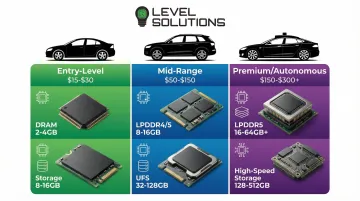
These ranges reflect memory chips only—they exclude integration costs, controller chips, and software licensing.
Entry-Level Vehicle Memory ($15-$30)
Budget vehicles typically use 2-4GB DRAM or LPDDR3/4 paired with 8-16GB eMMC/NAND for basic infotainment. These configurations support minimal connectivity, basic audio systems, and limited over-the-air update capability without advanced processing demands.
Mid-Range Vehicle Memory ($50-$150)
Mainstream vehicles deploy 8-16GB LPDDR4/5 and 32-128GB UFS/NAND to support connected services, advanced infotainment, and Level 1-2 ADAS features. This segment represents the fastest-growing market as consumer expectations for connectivity increase.
Premium/Autonomous Vehicle Memory ($150-$300+)
Premium EVs and autonomous vehicles require 16-64GB+ LPDDR5 with 128-512GB high-speed NAND/UFS, plus redundant storage for safety-critical systems. Memory content in these vehicles is approaching 2TB of combined DRAM and NAND to support Level 3+ autonomy, AI-powered features, and extensive OTA capabilities.
Key Factors That Affect the Cost of Automotive Memory
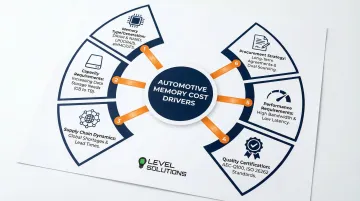
Memory costs can swing by 90% quarter-over-quarter, catching OEMs unprepared. Six interconnected factors drive these price movements, from technology transitions to supply chain concentration.
Memory Type and Technology Generation
Different memory types command different price points:
- LPDDR5 vs. LPDDR4: LPDDR5 commands premiums due to higher performance and tighter supply, with both experiencing ~90% QoQ surges in Q1 2026
- Technology transitions: DDR4/LPDDR4 phase-out drives prices up as automotive lags consumer electronics adoption
- Automotive-grade premium: Qualified memory costs 20-40% more than consumer equivalents due to extended temperature range (-40°C to +125°C)
The automotive industry's longer qualification cycles create a timing mismatch—by the time automotive designs qualify DDR4, consumer markets have moved to DDR5, reducing manufacturing volumes and increasing costs.
Memory Density and Capacity Requirements
Vehicle applications drive vastly different capacity needs:
- Basic infotainment: 2-4GB DRAM sufficient for simple interfaces
- Autonomous driving: 64GB+ DRAM required for real-time sensor fusion and AI processing
- Economies of scale: Higher-density modules often deliver better per-GB pricing but higher absolute costs
- Over-specification risk: Designing for future needs increases current costs but reduces redesign expenses
Supply Chain Dynamics and Market Competition
The memory supply chain is highly concentrated:
- Supplier concentration: Top 3 suppliers (Samsung, SK Hynix, Micron) control approximately 88% of automotive memory market
- AI competition: HBM demand for AI data centers will increase 70% year-over-year in 2026, pulling capacity from automotive
- Geopolitical factors: Manufacturing concentration in Asia creates vulnerability to trade restrictions and regional disruptions
This concentration limits automotive buyers' leverage when suppliers prioritize higher-margin AI and data center customers.
The imbalance directly impacts qualification requirements and pricing structures for automotive-grade components.
Quality Grade and Automotive Certification
Automotive-grade memory requires rigorous qualification:
- AEC-Q100 certification: Industry-standard qualification for automotive electronic components
- Extended temperature range: -40°C to +125°C operation vs. 0°C to +85°C for consumer parts
- Cost impact: Automotive certification typically adds 20-40% to component cost
- Qualification investment: $50,000-$200,000 per memory SKU for testing and validation
Consumer-grade alternatives appear cheaper but carry substantial risk. Reliability failures in automotive environments trigger warranty claims, recalls, and safety incidents that far exceed initial savings.
Vehicle Application and Performance Requirements
Different vehicle systems demand different memory specifications:
- Infotainment: Moderate speed requirements, focus on capacity
- ADAS: High bandwidth needs for sensor data processing
- Autonomous driving: Ultra-low latency requirements with bandwidth exceeding 200 GB/s
Performance Tiers:
- Standard LPDDR4: Baseline for mid-range vehicles
- High-speed LPDDR5: Premium vehicles and advanced ADAS
- Emerging LPDDR5X: Next-generation autonomous platforms
Safety-critical systems often require redundant memory configurations, doubling memory content for fail-safe operation. This redundancy becomes a major cost factor in autonomous vehicle platforms.
Procurement Strategy and Contract Terms
How you buy matters as much as what you buy:
- Spot buying vs. long-term contracts: Long-term agreements secure better pricing but sacrifice flexibility
- Volume commitments: Tiered pricing structures reward larger commitments
- Timing considerations: Locking in prices during market lows protects against spikes, but requires accurate demand forecasting
Strategic sourcing combines multiple approaches. Hybrid models pair local ESD-compliant warehouse inventory for immediate needs with global sourcing networks for volume commitments—balancing flexibility with supply security while optimizing total cost of ownership.
Cost Breakdown of Automotive Memory Procurement
OEM procurement teams often focus on component pricing, but automotive memory costs include multiple factors beyond the chip purchase. Understanding this complete cost structure helps decision makers evaluate suppliers and plan budgets accurately.
Component Purchase Cost
Type: Recurring (per vehicle)
The memory chip itself represents 60-75% of total memory cost. This varies by type and density, with market volatility affecting pricing throughout the supply chain.
Current automotive memory pricing (2026):
- DRAM: $15-20 per GB
- NAND/UFS storage: $0.30-0.60 per GB
Qualification and Integration Costs
Type: One-time (per platform/generation)
Automotive qualification testing, integration engineering, and validation across temperature, vibration, and EMI requirements typically cost $50,000-$200,000 per memory SKU.
The qualification cycle takes 6-12 months, creating significant lead-time constraints that OEMs must plan for.
Supply Chain and Logistics Costs
Type: Recurring
Supply chain expenses typically add 5-10% to component cost:
- Supplier management and quality oversight
- Inventory carrying costs
- Buffer stock for supply risk mitigation
- Logistics and handling
During periods of supply constraint, buffer inventory requirements increase substantially.
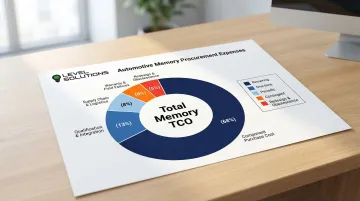
Warranty and Field Failure Costs
Type: Recurring (contingent)
Memory-related field failures, warranty claims, and potential recalls represent significant risk when using substandard components. Automotive-grade parts provide insurance against these costs through proven reliability in harsh conditions.
Redesign and Obsolescence Management
Type: Periodic
When memory components become obsolete or unavailable, OEMs face platform redesign costs, requalification expenses, and potential production delays. DDR4/LPDDR4 phase-outs are forcing these costs on OEMs who didn't plan for technology transitions.
Low-Cost vs High-Cost Automotive Memory — What's the Difference?
Budget memory solutions and premium automotive-grade options represent different value propositions. In practice, "low-cost" often translates to higher total cost of ownership.
Performance and Reliability
The performance gap between consumer and automotive-grade memory becomes clear under real-world conditions.
Consumer-grade components operate within standard temperature ranges (0°C to +85°C). That's adequate for controlled environments but insufficient for automotive applications where under-hood temperatures routinely exceed 100°C and winter conditions drop below -30°C.
Automotive-grade memory delivers:
- AEC-Q100 certification for automotive environments
- Extended temperature range (-40°C to +125°C)
- Higher write endurance for event logging and diagnostics
- Lower failure rates in thermal cycling and vibration
The difference matters when a memory failure triggers a warranty claim costing $2,000+ in diagnostic time and replacement parts—versus the $5-15 difference in component cost.
Supply Stability and Longevity
Vehicle platforms require component availability for 10-15 years. Consumer electronics move to newer generations every 18-24 months.
This mismatch creates supply risks:
- Consumer-grade parts face rapid obsolescence
- Limited supply commitments from manufacturers
- Allocation cuts during shortages prioritize high-volume consumer markets
- Redesign costs when components become unavailable mid-production
Automotive-grade memory typically carries longer lifecycle commitments matching vehicle platform requirements. Suppliers offer guaranteed supply agreements and priority allocation during market tightness. This stability prevents the redesign costs that can reach $500K-2M per platform when a critical component goes obsolete.
Total Cost of Ownership
A $3 consumer-grade memory chip versus an $18 automotive-grade equivalent seems like an obvious $15 savings per unit. On 100,000 vehicles, that's $1.5M in component costs.
But the cost equation shifts when you factor in:
| Cost Factor | Consumer-Grade Risk | Automotive-Grade Protection |
|---|---|---|
| Field failure rate | 2-5% over vehicle life | 0.1-0.5% over vehicle life |
| Warranty cost per failure | $1,500-3,000 average | $1,500-3,000 average |
| Supply disruption redesign | $500K-2M per platform | Guaranteed supply agreements |
| Recall exposure | Higher with temperature-related failures | Minimal with qualified components |
On 100,000 vehicles with 3% failure rate, warranty costs alone reach $4.5M-9M. The $15 component savings becomes a $3M-7.5M net loss.
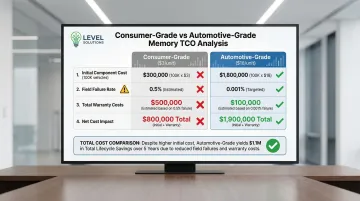
LEVEL SOLUTIONS sources both consumer and automotive-grade memory components. For OEM applications requiring proven reliability and long-term availability, automotive-qualified options consistently deliver lower total cost despite higher unit pricing.
How to Estimate the Right Budget for Automotive Memory
The "right" budget balances performance requirements, supply reliability, and total cost of ownership. OEMs focused solely on lowest unit price often face supply disruptions, qualification delays, and costly failures down the line.
Key Budgeting Considerations:
- Vehicle segment and target market: Entry-level buyers tolerate basic connectivity; premium buyers expect seamless digital experiences
- Memory requirements by application: Calculate needs for infotainment capacity, ADAS processing, autonomous driving data handling, and OTA update storage
- Supply risk tolerance: Premium for supply stability vs. exposure to spot market volatility
- Product lifecycle and platform longevity: 7-10 year vehicle lifecycles require guaranteed long-term memory availability
- Total cost of ownership: Factor in component cost, qualification, integration, supply chain risk, and potential failure costs
- Sourcing strategy: Suppliers with global sourcing and immediate availability reduce buffer inventory costs—Level Solutions combines local ESD-compliant warehousing with access to billions of parts worldwide
What Most People Miss When Budgeting for Automotive Memory
Many OEMs focus exclusively on component unit prices while ignoring supply stability and total cost of ownership. Yet production line shutdowns due to memory shortages create losses that dwarf any component savings.
Common budgeting blind spots include:
- Unit price obsession — Supply disruptions cost far more than price premiums when lines go dark
- Commodity assumptions — Automotive-grade certification (AEC-Q100) and extended temperature ranges justify premiums over consumer parts
- Obsolescence underestimation — DDR4/LPDDR4 phase-outs are forcing costly platform redesigns as legacy availability shrinks
- AI market competition — Data center demand now competes for the same memory capacity, pushing automotive allocations lower during constraints
- Spot market dependence — Reactive buying during shortages inflates costs and delays production
Building relationships with suppliers who maintain both local inventory and global sourcing capabilities mitigates these risks. Immediate warehouse availability addresses urgent needs, while worldwide sourcing networks provide access to allocated and hard-to-find components before shortages impact production schedules.
Conclusion
Automotive memory costs vary widely based on memory type, vehicle application, quality grade, and market conditions. With 2026 forecasts showing 90-95% DRAM price increases, OEMs face unprecedented procurement challenges.
The "right" cost balances multiple factors beyond unit price:
- Supply reliability and allocation security during shortages
- Automotive-grade quality standards (AEC-Q100, IATF 16949)
- Total cost of ownership including qualification, testing, and failure costs
- Long-term supplier relationships that ensure priority during tight supply
Strategic procurement delivers better outcomes than pure price optimization in today's volatile market. For OEMs navigating 2026's pricing pressures, partnering with experienced component specialists like LEVEL SOLUTIONS—with millions of memory components in ESD-compliant warehouses and access to global supply networks—provides the sourcing stability and quality assurance critical to production continuity.
Frequently Asked Questions
What is the typical cost range for automotive memory solutions in 2026?
Automotive memory costs range from $15-$30 per vehicle for entry-level applications to $150-$300+ for premium and autonomous vehicles. Prices have increased 70-100% compared to 2025 due to supply constraints and AI demand pulling capacity away from automotive.
Why are automotive memory prices increasing so dramatically?
AI data center demand is pulling memory supply away from automotive applications, with suppliers prioritizing higher-margin HBM production. Automotive-grade DDR4/LPDDR4 are being phased out while automotive designs still depend on them, creating supply-demand imbalances.
How much do different memory types cost for automotive applications?
Automotive DRAM costs approximately $15-20 per GB in 2026, while NAND/UFS storage runs $0.30-0.60 per GB. Automotive-grade versions with AEC-Q100 qualification command 20-40% premiums over consumer equivalents due to extended temperature range and reliability requirements.
Should OEMs prioritize price or supply stability when sourcing automotive memory?
Supply stability is increasingly more critical than price optimization. Production disruptions cost far more than price premiums, especially for vehicles with long development cycles. Relationships with suppliers offering guaranteed allocation protect against costly production delays.
What factors have the biggest impact on automotive memory pricing?
Memory type and technology generation (LPDDR5 vs. LPDDR4), automotive-grade certification (AEC-Q100), supply-demand dynamics from competing AI markets, and procurement strategy (spot vs. long-term contracts) drive the largest pricing variations.
How can OEMs reduce memory costs without compromising vehicle performance?
Optimize memory allocation to avoid over-specification, establish long-term supplier relationships for better pricing and allocation priority, and partner with suppliers offering global sourcing and immediate availability to reduce buffer inventory costs while maintaining supply security.